How big are Pyrrhia and Pantala in Wings of Fire?
SPOILERS FOR ARCS 1 AND 2, and BOOK 11.
Every time I come across a grand fantasy world in novels, films, and games, I want to know everything about it. What’s the history behind it? What’s beyond its borders? And of course, the age-old question, how big is it? In a video game like The Legend of Zelda: Breath of the Wild, the world is interactive. If you had a lot of patience and free time, you could just walk all the way across the map and do some simple math to estimate the size.
But here in the Wings of Fire world, we don’t have that luxury. What we do have, is this map.
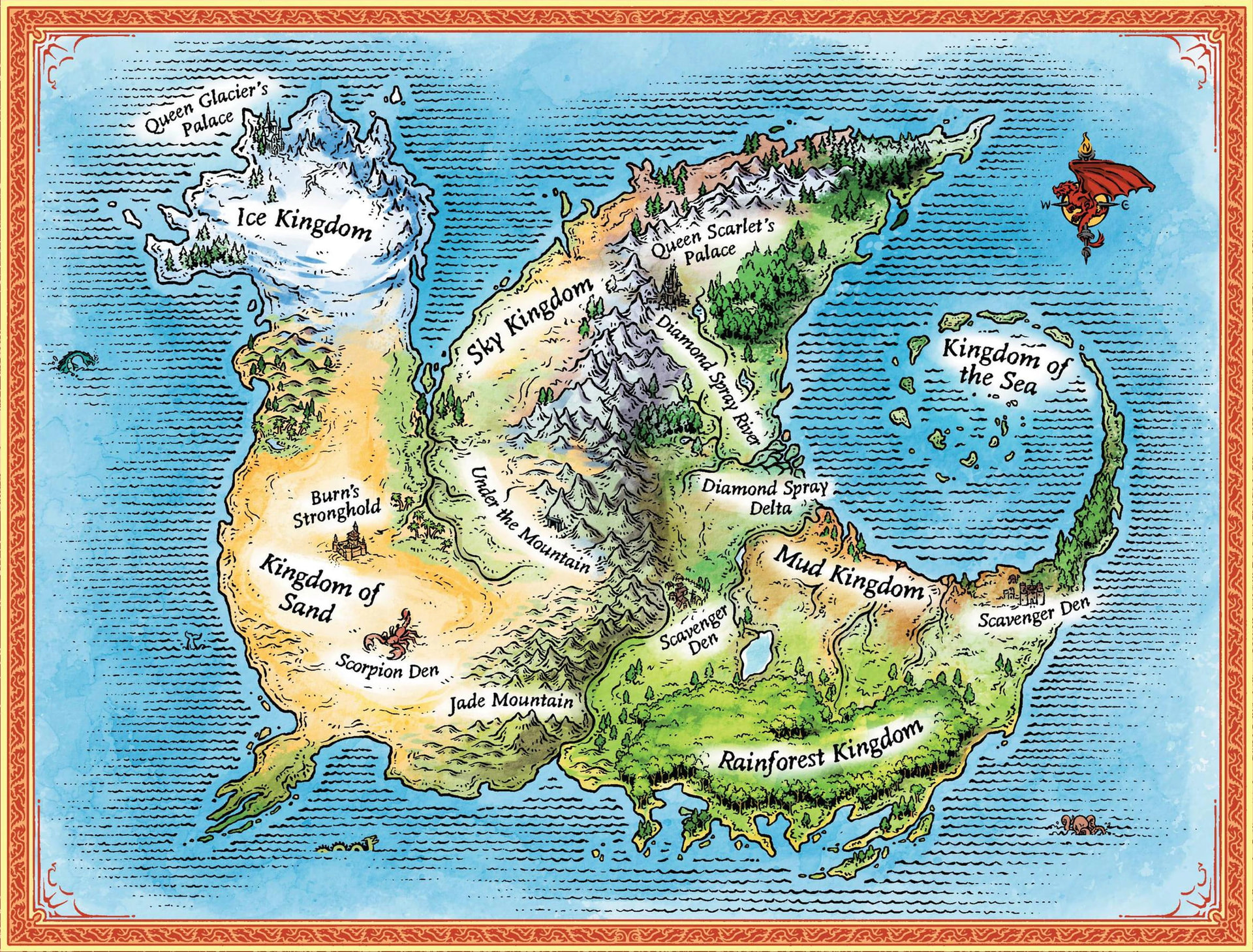
The first five books have this map at the beginning of each novel to give you some context about where things are in the world. If we’re going to make an accurate map of Pyrrhia, this is going to be our number one resource.
Or at least it would’ve been if not for this.
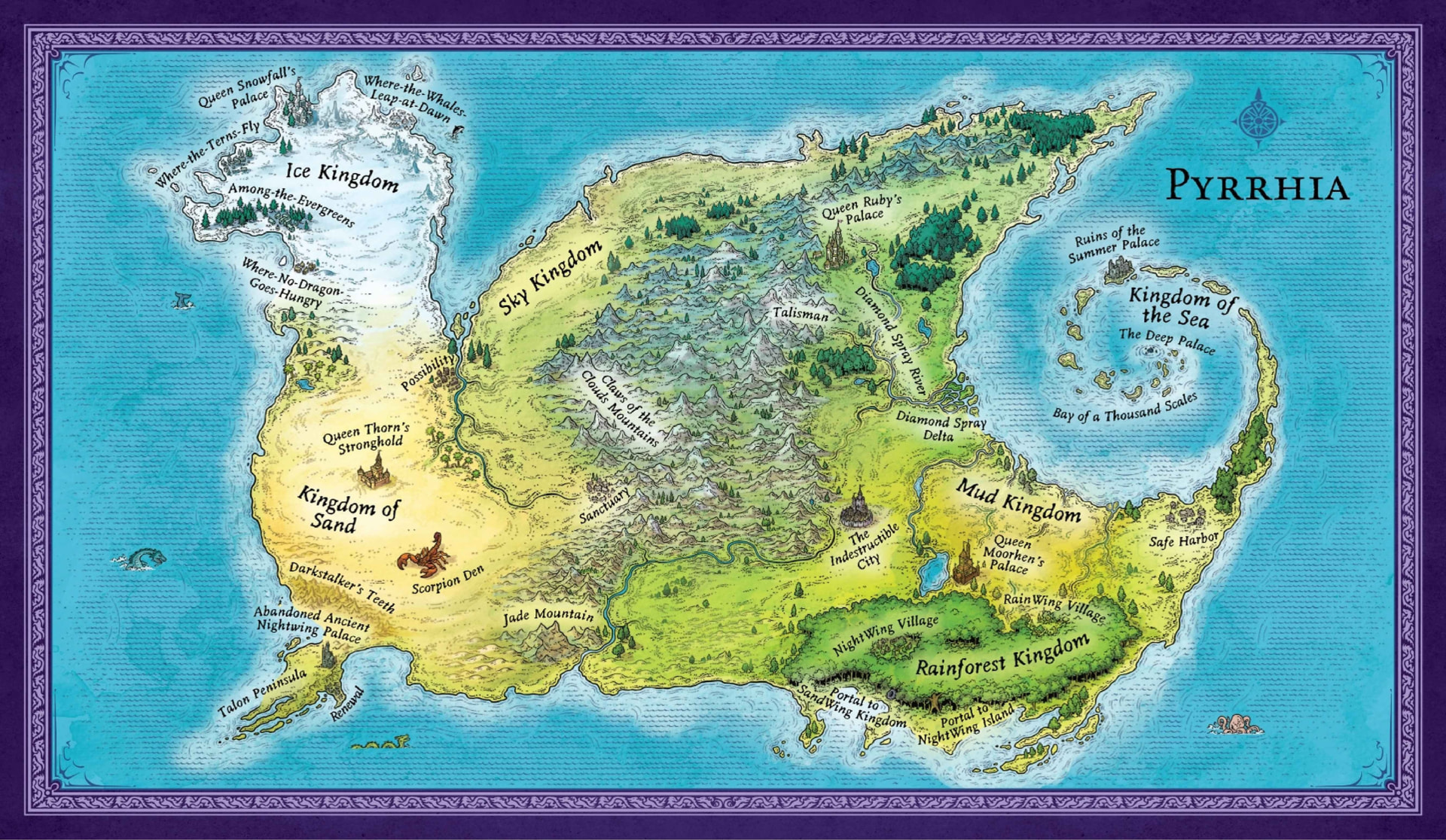
A Guide to the Dragon World. This supplementary book has all sorts of neat information about the world and characters that we otherwise wouldn’t have the opportunity to get. But most crucially, there are updated versions of the maps here that include more detail than ever and are actually a bit wider than the previous maps. I wasn’t sure whether this was stretched a little bit to accommodate the wider pages of the guide book or if the Pyrrhia is actually just wider than the NightWing mappers of the first books thought.
There are smaller square maps for each of the tribes further in the book and I overlaid them on the big map and sure enough, there’s no stretching here. Pyrrhia is actually just wide.
Now that we have our maps mostly sorted out, we need to lay down some basic assumptions. The world in Wings of Fire is very Earth-like with oceans and mountains and trees and snow and day and night and rain. There are moons and dragons have a unit of time called years which I’m going to assume is the same as we have. So we’re going to play by a lot of Earth’s rules. Thus, the world is a globe that is about the same size as Earth and the same distance from the sun with the same speed of orbit and rotation.
Now, we have an empty oceanic globe, and we need to put Pyrrhia somewhere on it. The Pyrrhia map has this little cardinal direction indicator that looks like a compass pointing north, south, east, and west. However, I think this is a red herring that we can actually ignore.
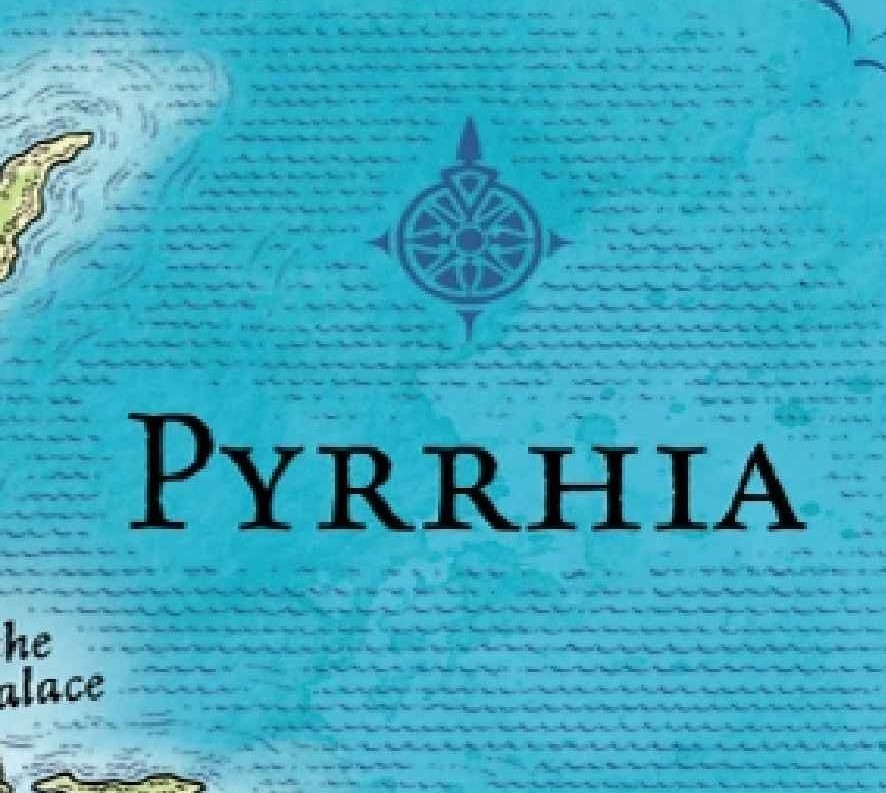
In the real world, all the cardinal directions were originally derived using a magnetic compass which points to the axis of the magnetic field of the Earth. However, the dragons don’t actually appear to have compasses. I didn’t find any reference to compasses, or even magnets in general, in any of the novels. (There was one where Tsunami says “this school is a magnet for disaster” or something like that but I think that can be ignored as a logical error.) That means that the unless the dragons somehow know that the axis of the planet is somewhere in the middle of the freezing endless ocean, then we can pretty safely assume that the dragons don’t actually base their cardinal directions on the planet, but rather the continent itself.
The north, south, east, and west cardinal directions are indeed mentioned throughout the novels, but without a compass to anchor them, these directions must have been arbitrarily assigned, perhaps using the dragon-like image of the continent, rather than based on the planet’s axis.
Basically, this means nothing to us and is not helpful. So Pyrrhia’s actual orientation probably doesn’t look like it does in the map. It’s probably more like this.
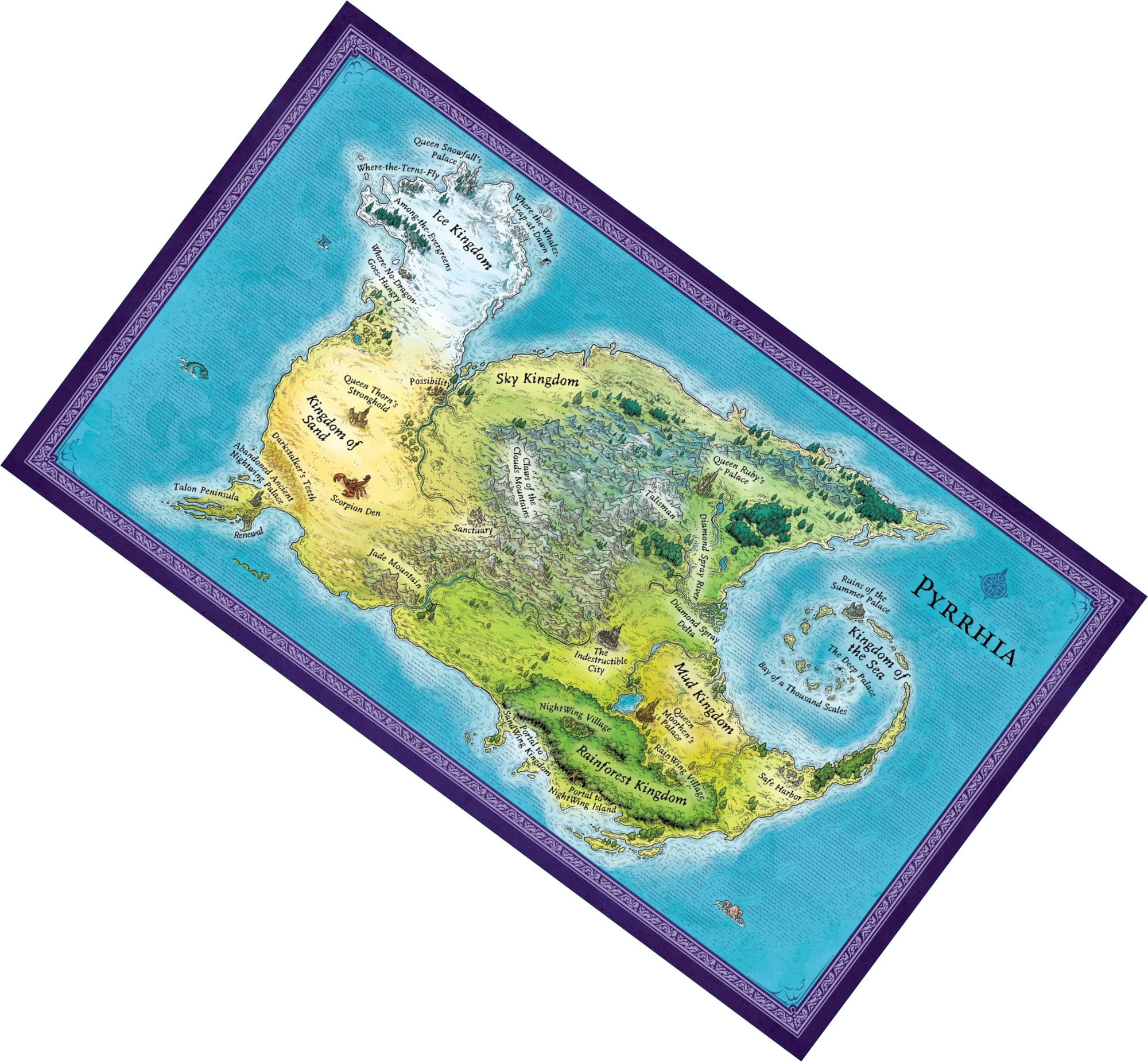
Pyrrhia is super diverse. And notice that we have both a snowy tundra and a tropical rainforest on opposite sides. In real life, the difference in the amount of sunlight along the surface of the Earth causes the climate of the equator to be very warm and the climate of the poles to be very cold. So along the equator we have a lot of biomes that are classified as tropical, including tropical rainforests. And at the poles, the cold, low-precipitation biomes are classified as tundra.
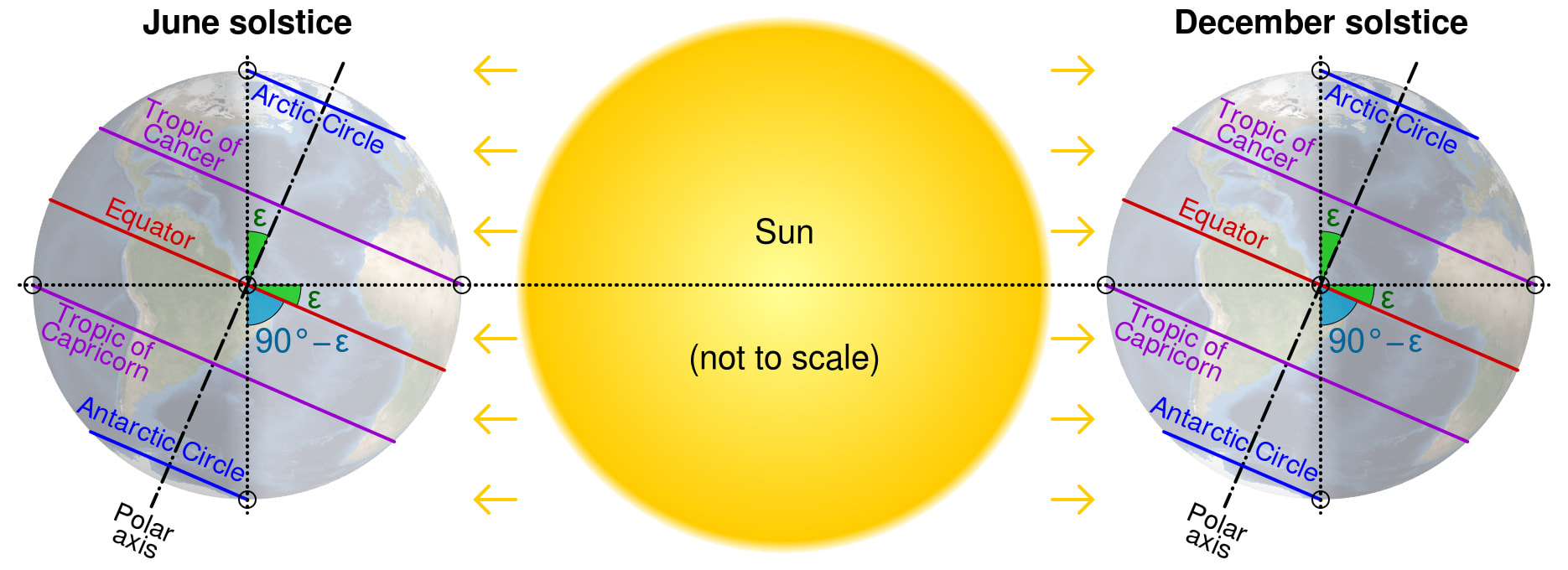
I’m sure you can see where I’m going with this. The Rainforest Kingdom is along the equator while the Ice Kingdom is at one of the poles. We can actually be reasonably sure that it’s near the north pole rather than the south pole because it’s been shown that the sun rises in the east and sets in the west. I know I said the cardinal directions weren’t helpful to us before, but it can help us verify that our placement is correct because if the continent were the other way around, with the Ice Kingdom near the south pole, the continent is flipped on its head along with the directional compass, and in this configuration the directions would be reversed, which contradicts what we see in the books. So Pyrrhia has to be oriented like this.
I don’t think the Ice Kingdom is on the north pole because if that were the case, the daylight hours would be a little weird at the IceWing palace but in the books, its shown to follow roughly the same hours as the rest of the world, so it’s not all the way up there.
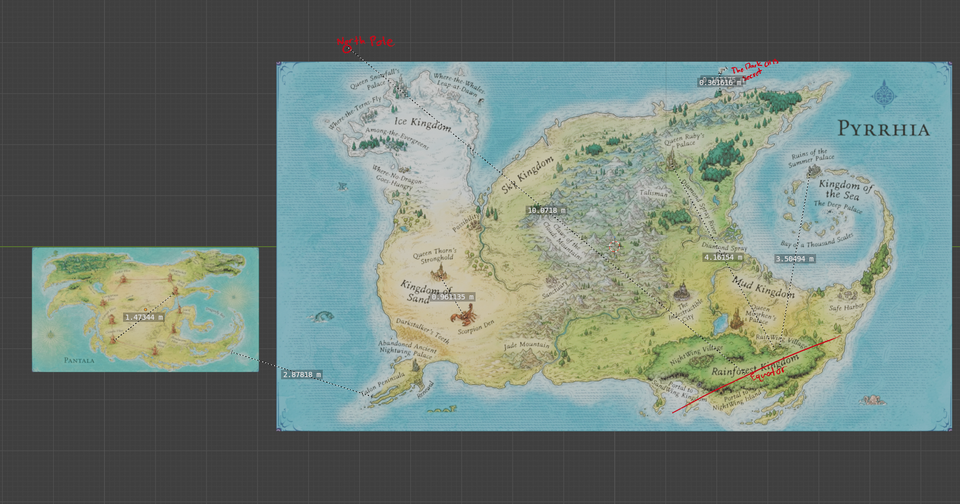
Let’s stop here for a moment and take a look at the size of Pyrrhia. If this planet is indeed similar to Earth, then we already know its size and we can use that to estimate the size of Pyrrhia. The real-life distance from the north pole to the equator is about 10,000 kilometers or 6,200 miles. The Ice Kingdom isn’t exactly on the north pole, so we’ll take off a thousand kilometers, giving us a distance of about 9,000 kilometers from Queen Snowfall’s Palace to the middle of the Rainforest Kingdom.
For reference, the distance between San Francisco, California and New York City, New York is a little under half that distance at about 4,100 kilometers.
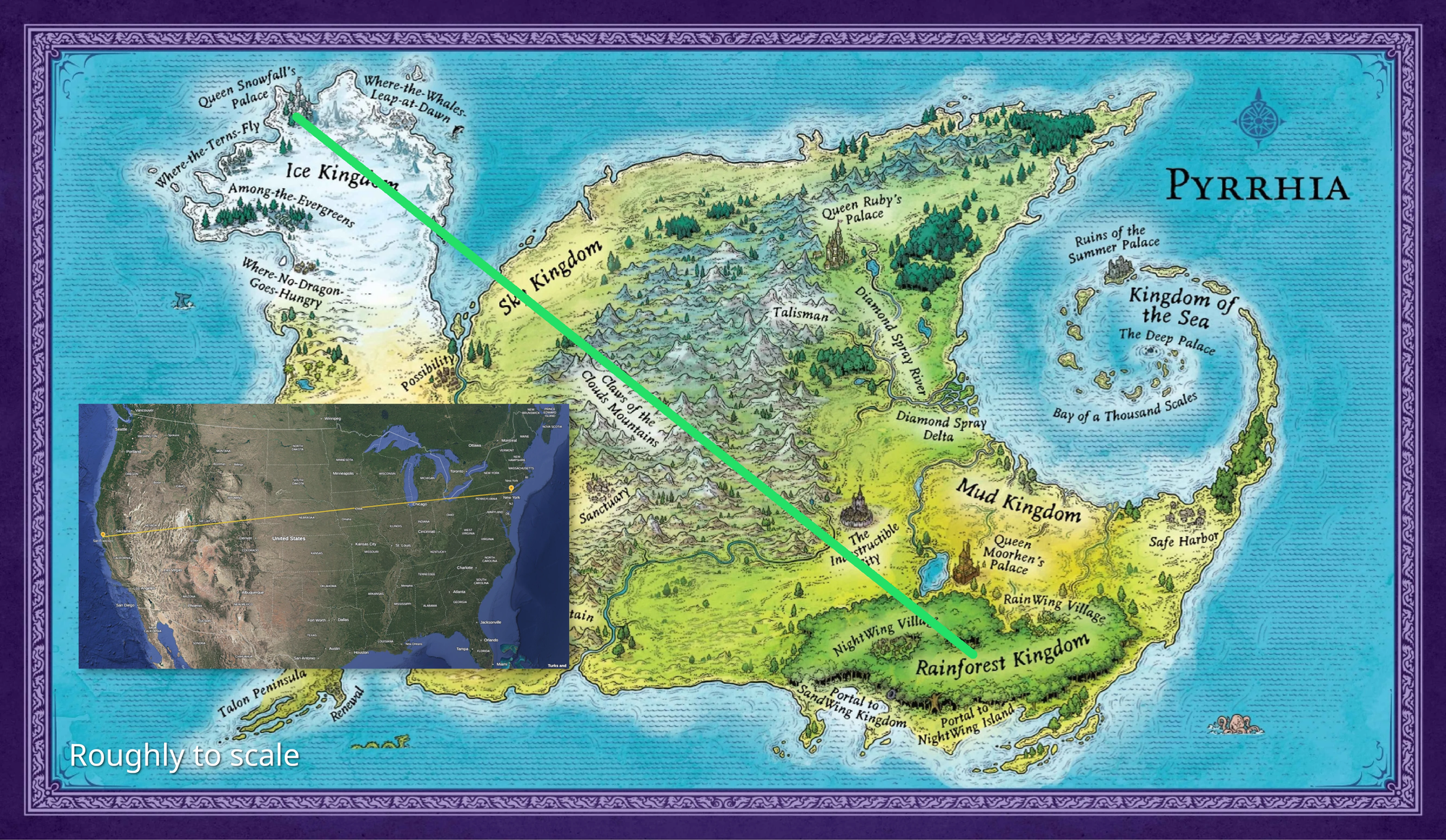
Yikes. That seems a little too big, right? Well, I did some more digging and it turns out this might actually be correct. Foeslayer mentions that the NightWing scientists thought that Pyrrhia makes up of a third of the entire planet, and while this is not quite at that size, Pyrrhia is extremely large.
It’s also worth considering that everything in this world is a lot bigger. The dragons are many times larger than humans and can literally fly through the air at high speed, so for a dragon continent with dragon kingdoms, the size isn’t unreasonable.
I don’t know if Tui had all this in mind when working out the world or if it just seemed to make sense this way and it conveniently lines up like this. Either way, with our current measurements, we can discover some cool facts.
- The distance that the Dragonets of Destiny traveled from the SkyWing Palace to the Diamond Spray Delta is about 1,750 km or 1,000 miles. That’s about the same distance as if you were flying between New York City, New York to Miami, Florida.
- The distance they then traveled from the Summer Palace to the RainWing village is about 3,500 km or 2,200 miles. That’s about the same distance as Moscow, Russia, to Madrid, Spain.
The size even correlates well with other distances referenced in the books. In book five, when Sunny follows Fierceteeth, Preyhunter, and Strongwings, it takes them four days to get from the portal to the edge of the desert, which is about 4,250 kilometers. That’s about 96 hours of flying, but they also sleep during the night until sunrise and take frequent breaks during the day, so we’ll say 72 hours of flight. That’s just about 60 kilometers per hour or 35 miles per hour, which seems pretty reasonable to me for dragon flight.
Just to be sure, I did a bit of searching and found that most birds typically fly at between 30 and 50 kilometers per hour, so this estimate doesn’t seem unrealistic.
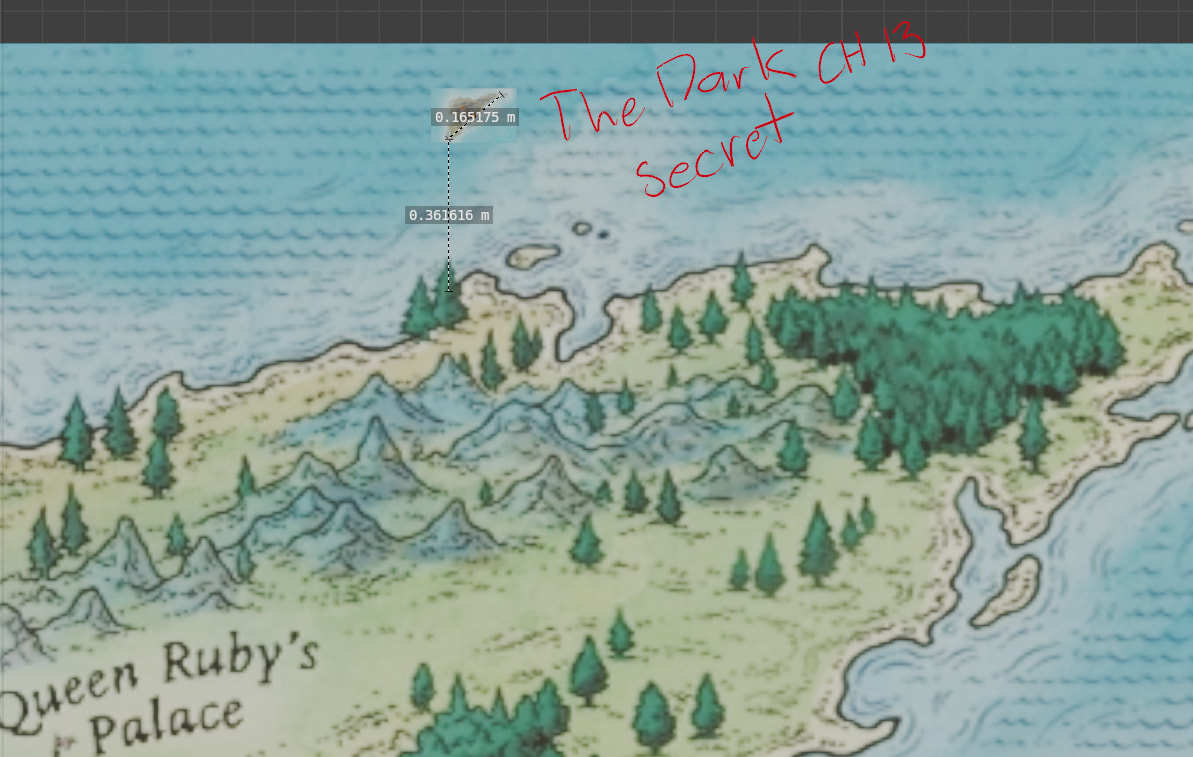
I also want to figure out where the Volcanic NightWing Kingdom is. We know it’s somewhere north of the Sky Kingdom because in The Dark Secret, Starflight and the alternate dragonets of destiny fly from the island to a remote SkyWing outpost on the northern coast. We don’t really get any specific details on where this outpost is, though. Morrowseer says it’s the most remote one in case of an IceWing attack to the palace from the north. Unfortunately, that’s all we have. If I had to guess, I’d say it’s not quite all the way out toward the tip, nor is it super close to the palace, but that’s a lot of assumptions. I don’t think we’ll ever really know for sure.
As for the distance, it’s hard to say as well. The group leaves in the morning, spends a short time on the continent, then turns back and arrives sometime in the evening. Let’s assume a six-hour flight between the island and the continent then. That would make a day for the round trip. Using our 60 kilometer-per-hour estimate from before, that puts the island at just 360 kilometers away. I say just because it looks pretty small on the map, but that’s the same as the distance between Los Angeles, California and Las Vegas, Nevada. But again, we don’t have precise references here so take another grain of salt.
As for the size, it’s really hard to say. I decided to use Hawaii as a reference, since it’s also a volcanic island. That puts the Volcanic NightWing Kingdom at about 165 kilometers from tip to tip. It certainly doesn’t looks very substantial on the map, but that’s only because the scale of the drawings are so different. Yet again, we have no real references so this is the third grain of salt I’ll be asking you to take.
So I feel pretty good about the placement and size of Pyrrhia, but what about Pantala? The scale of the map makes it look like the same size as Pyrrhia, but that would make the silk bridge between Cicada Hive and Hornet Hive over a thousand kilometers long, and I just don’t think that the dragons could realistically make a bridge that spans the distance from Portland, Oregon to Las Vegas, Nevada. Like, for physics reasons that bridge would just not be able to exist. The only connection points are the hives with no supports between, and while I trust the silk is both lightweight and strong, you eventually hit a limit of strength, weight, and distance where the forces just don’t allow you to make the bridge any longer.
In fact, for these bridges to exist at all, Pantala has to be several times smaller than Pyrrhia, and the uniformity of Pantala’s climate as well as evidence in the in the novels themselves lead me to believe that Pantala has to be a fraction of the size of Pyrrhia.
Since we have Pyrrhia’s size and position more or less figured out, we can use it to help us determine where to place Pantala. In the prologue of the Lost Continent, we learn that it took Clearsight about two days of continuous flying to get to Pantala. We don’t know exactly where Clearsight took off from, but it was probably somewhere around the Talon Peninsula. If we use our 60 kilometer-per-hour estimate from before, flying for fourty-eight hours gives us about 2,880 kilometers of distance between the Talon Peninsula and… somewhere on Pantala. It’s not exactly clear where Clearsight lands and meets the Pantalan dragons. It’s some kind of forest, but with all the trees wiped out in the present day, there’s no indication of where that could be. If I had to guess, it would most likely be somewhere along the tail of Pantala. And that does put it at the edge of the map of Pyrrhia. But that’s a lot of assumptions.
The exact size of Pantala is hard to figure out too. I decided to look at flight times again and it took about half a day for Blue, Cricket, and Swordtail to get halfway between Cicada Hive and Wasp Hive. But there’s a problem. At this halfway point, they find the big pit and hide down there. But this doesn’t make very much sense because it’s not between Cicada and Wasp. It’s all the way over to the northwest. That’s a pretty massive detour they would have had to take.
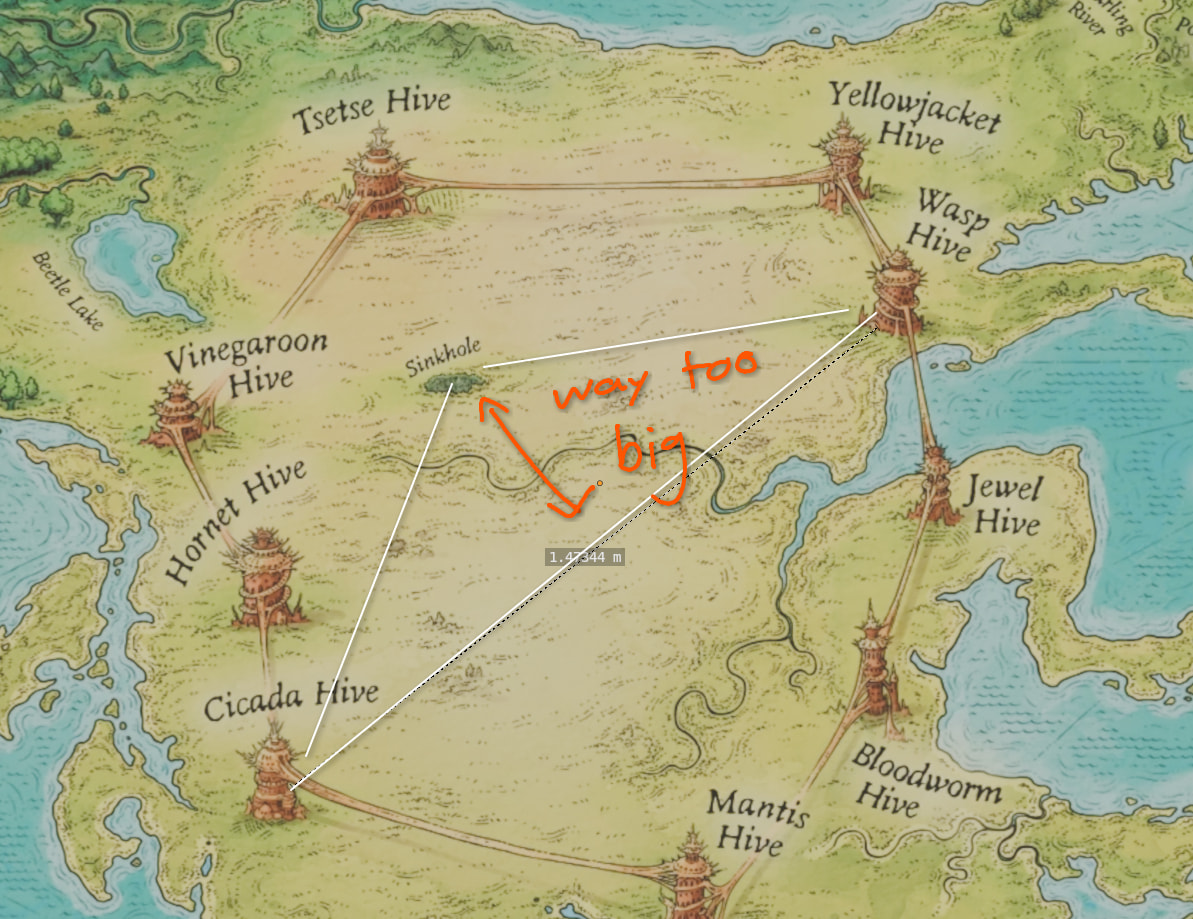
So I don’t really know how big exactly Pantala is, but it makes sense for it to be smaller.
Still, the books are not entirely accurate on the sizing throughout. There are little discrepancies that break it all apart at the seams because Tui probably didn’t have everything meticulously planned and mapped out. She probably just did whatever worked well in the story, which in my opinion should absolutely come before geological accuracy.
Member discussion